
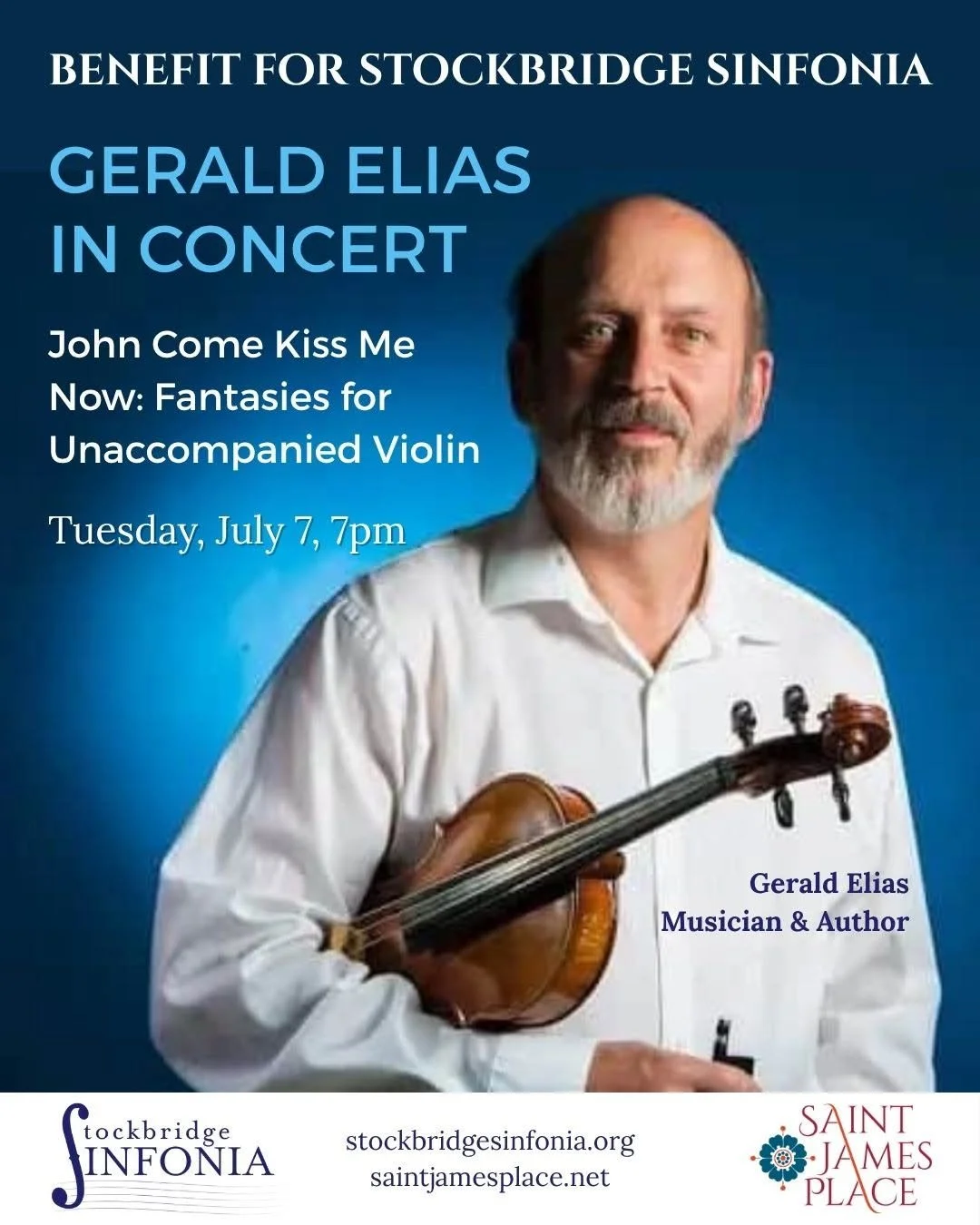
Fantasies for Solo Violin
with acclaimed violinist Gerald Elias
A concert to benefit the Stockbridge Sinfonia Student Award Fund and concert season expansion
July 7, 2026
Thank you to our donors to the silent auction: Beacon Cinema, Bousquet Sport, Yao’s, the Clark Museum, Mac-Haydn Theater, Berkshire Fitness & Wellness Center, John Keal Music, Central Radio, Jae’s, Spirited, the Clip Shop, Taft Farms, On A Roll Cafe, Mary Lee Ledbetter, Zucchini’s, Market 32, Loeb’s, Karen Berger, Gerald Elias, Papa Joe’s, Stop & Shop, Big Y.
PROGRAM
Preludio and Fantezia in A Major - Pedro Lopes Nogueira (1686–after 1770)
Fantasia IX in B Minor - Georg Philipp Telemann (1681–1767)
Siciliana, Vivace, Allegro
*Sonata No. 2 in A Minor, BWV 1003: Grave - Johann Sebastian Bach (1685–1750)
*Fantasia in A Minor - Nicola Matteis, the Younger (c.1690–1749)
Assaggio No. 4 in C Minor - Johan Helmich Roman (1694–1758)
Grave, (Allegro), (Andante), (Allegro)
Suite in A Major for Solo Violin - Johann Paul von Westhoff (1656–1705)
Prelude, Allemande, Courante, Sarabande, Gigue I, Gigue II.
Prelude in C Minor, and “John come kiss me now” - Thomas Baltzar (c.1630–1663)
*performed without interruption
The evening opens with an introductory talk by Elias that sets the stage for the recital. Following the performance there will be a reception and silent auction, including items from Beacon Cinema, Bousquet Sport, Spirited, Jae’s, Clark Art Museum, Central Radio, Berkshire Fitness & Wellness Center, Mac-Haydn Theater, Yao’s Restaurant, John Keal Music, Mary Lee Ledbetter, Karen Berger, Papa Joe’s, Taft Farms, Loeb’s, Zucchini’s, Market 32, Stop & Shop, the Big Y, the Clip Shop, and signed copies of Elias’s latest book, Murder on Vacation.
The musical "Fantasy" is a highly expressive form that traces its origins to the 16th century. It is particularly well-suited to an unaccompanied violinist, who can freely change tempos and dynamics, and improvise in the moment. The program includes rarely performed virtuoso fantasies by 17th- and 18th-century composers Nogueira, Telemann, Bach, Matteis the Younger, Roman, von Westhoff, and Baltzar. Elias will perform on a 2025 violin made by his son, Jacob Elias, and styled after one by the great Cremonese maker, Giuseppe "del Gesù" Guarneri.
Gerald Elias is a former violinist with the Boston Symphony and associate concertmaster of the Utah Symphony. He has been music director and conductor of Salt Lake City’s Vivaldi by Candlelight chamber orchestra series since 2004 and is also a prize-winning author of 11 mystery novels and many short stories. His most recent book, Murder on Vacation, published in May, is a lighthearted collection of 16 short crime mysteries, one of which takes place in Great Barrington.
Elias noted, “I’ve had the pleasure and honor of working with the Stockbridge Sinfonia for 15 years, and my recital on July 7th is my opportunity to give back a little of what I’ve gained from that wonderful experience.”
PROGRAM NOTES
Preludio and Fantezia in A Major, Pedro Lopes Nogueira (1686–after 1770)
Lisbon, Portugal was a center of Baroque music. But in 1755 there was an earthquake of 7.7 on the Richter scale and 30–40,000 people perished, of course along with devastating destruction of the entire city. Nogueira survived, which we know from a single document with his name in 1770. Fortunately, what also survived was an incredible volume of over 300 pages of his violin music, now referred to as the Nogueira Manuscript. It includes technical exercises, cadenzas, sonatas, and two-dozen two-movement fantasies covering almost all 12 notes of the chromatic scale.
The first movement of each fantasy, which he calls a Preludio, is very freely composed, exploring exotic harmonies and lacking even bar lines! The second movement, Fantezia, in contrast, is lively and rhythmic and fully grounded in a bright A Major.
Fantasia IX in B Minor, TWV 40:20, Georg Philipp Telemann (1681–1767)
Siciliana, Vivace, Allegro
Telemann, with over 3,000 known works, was perhaps the most prolific composer who ever lived. In his day, he was certainly much more famous and well-traveled than Bach, an almost exact contemporary.
The Fantasia in B Minor, one in a set of a dozen for unaccompanied violin, is much like a sonata, with three contrasting movements, each in bipartite structure. What is atypical is that none of the movements slow. The first is a lilting Siciliana; the second, a robust Vivace, is followed by a coda-like Allegro.
Grave, Sonata No. 2 in A Minor, BWV 1003, Johann Sebastian Bach (1685–1750)
This is the only piece on the program that most of you may have probably heard before. Bach’s six sonatas and partitas for solo violin are the Bible for any serious violinist, and certainly the musical pinnacle for the solo violin literature.
I chose this movement because of its resemblance to the through-composed, free flow of ideas in Nogueira’s Preludio that began the program. In contrast to the Nogueira, this movement by Bach in A Minor is more introspective and brooding.
Fantasia in A Minor, Nicola Matteis, the Younger (c.1690–1749)
Nicola Matteis, the Elder, was born in Italy but then––like many other Italian composers––relocated to England and made his career there. His son, Nicola, the Younger, was born in England, but spent most of his life in Vienna before returning to England later in life. Regardless of whether one considers him Italian, English, or Austrian, he composed perhaps the most unusual piece on the program.
In its four minutes, there is a slowly modulating kaleidoscope of harmonic changes in which every time a phrase seems to be coming to an end, it travels off in an unexpected direction. The music is written only as a sequence of long-note chords, but the performer (as was the style of the day) was fully expected to arpeggiate the chords. How that is executed is up to the individual performer’s own creative inclination.
Assaggio No. 4 in C Minor, Johan Helmich Roman (1694–1758)
Grave, (Allegro), (Andante), (Allegro)
The Swedish composer, Johan Helmich Roman is yet another composer who most concertgoers are not familiar with, as least in here in the U.S. Yet, in Sweden, he is quite well known and is often called “the Swedish Handel.” He did, in fact, spend time in London, where he got to know Handel and his music, which he proudly emulated. He also traveled throughout Europe, bringing back to Sweden a much more cosmopolitan style of composition.
The Assaggio in C Minor is one of a set of six. “Assaggio” is a curious title, and Roman is the only composer who, at least to my knowledge, ever used it. It’s an Italian word that means “a sampling” or “a taste.” In effect, an appetizer, which attests to Roman’s humility, perhaps. It’s much more than an appetizer, however, and is definitely the most dramatic and substantial work on the program. You’ll notice that I’ve indicated the tempos of three of the movement in parentheses. That’s because Roman didn’t bother to put any tempo marking on the page at all, assuming that the performer, using their own good taste and understanding, would intuit the correct tempo. He was not alone in this assumption. Many Baroque composers apparently were more trusting of the performers who would play their music than their successors.
Suite in A Major for Solo Violin, Johann Paul von Westhoff (1656–1705)
Prelude, Allemande, Courante, Sarabande, Gigue I, Gigue II.
Westhoff is not a household name among Baroque composers, yet he was a significant composer in his day. His six suites were among the first ever substantial set of works for unaccompanied violin, to the extent that they inspired Bach to follow suit a generation later. The suite I’m performing today predated the set of six by about a decade and may have been composed for King Louis XIV.
The first movement, Prelude, has the characteristics of a fantasy, with the opening chorale-like chordal phrases repeated as rapid arpeggiation. It’s followed by four short dances typical of French suite, with alternating tempo and mood, and while embracing the elegance of the French style, is a fine example of German contrapuntal technique.
Prelude in C Minor, and “John come kiss me now,” Thomas Baltzar (c.1630–1663)
Thomas Baltzar was born in Germany, and like so many musicians at that time, moved to London to ply his trade. He was known as a fine violinist with exceptional skill as an improvisor. Sadly, he died very young––some say from an excess of partying––and left behind very little music.
The two-minute Prelude, found in manuscript form in the Bodleian Library at Oxford, is a somber, liturgical-sounding, work with hints of earlier 17th-century Renaissance harmony. In sharp contrast is “John come kiss me now,” which first appeared in print in Playford’s Division Violin in 1684, long after Baltzar’s death. “John come kiss me now” is based on a popular song of that era, and Baltzar was one of at least several composers to use it as a theme for a set of variations. Baltzar’s rendition demonstrates the intersection of “classical music” and “traditional” fiddling, highlighted by various feats of chord-playing and highspeed lefthand virtuosity.
Program notes by Gerald Elias
Wind Ensemble: Serenades
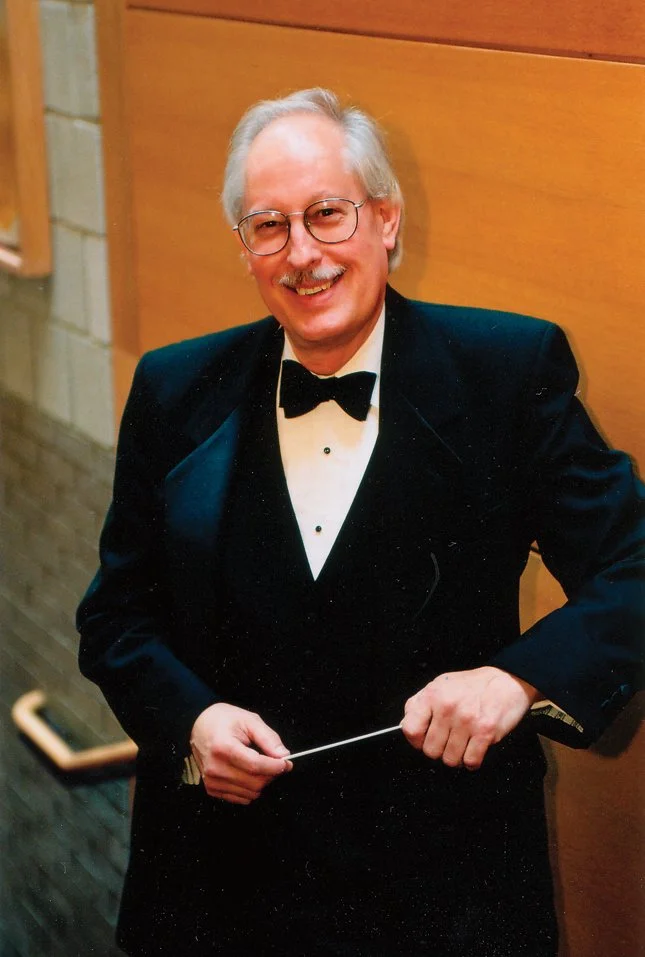
with guest conductor David Diggs
June 27 and 28, 2026
PROGRAM:
Serenade in E-flat, Op. 7 Richard Strauss (1864 - 1949)
Serenade No. 11 in E-flat, K. 375 Wolfgang Amadeus Mozart (1756 - 1791)
I. Allegro maestoso II. Menuetto
III. Adagio
IV. Menuetto
V. Allegro
Serenade in D minor, Op. 44 Antonín Dvořák (1841 - 1904)
I. Moderato, quasi marcia II. Minuetto
III. Andante con moto
IV. Finale: Allegro molto
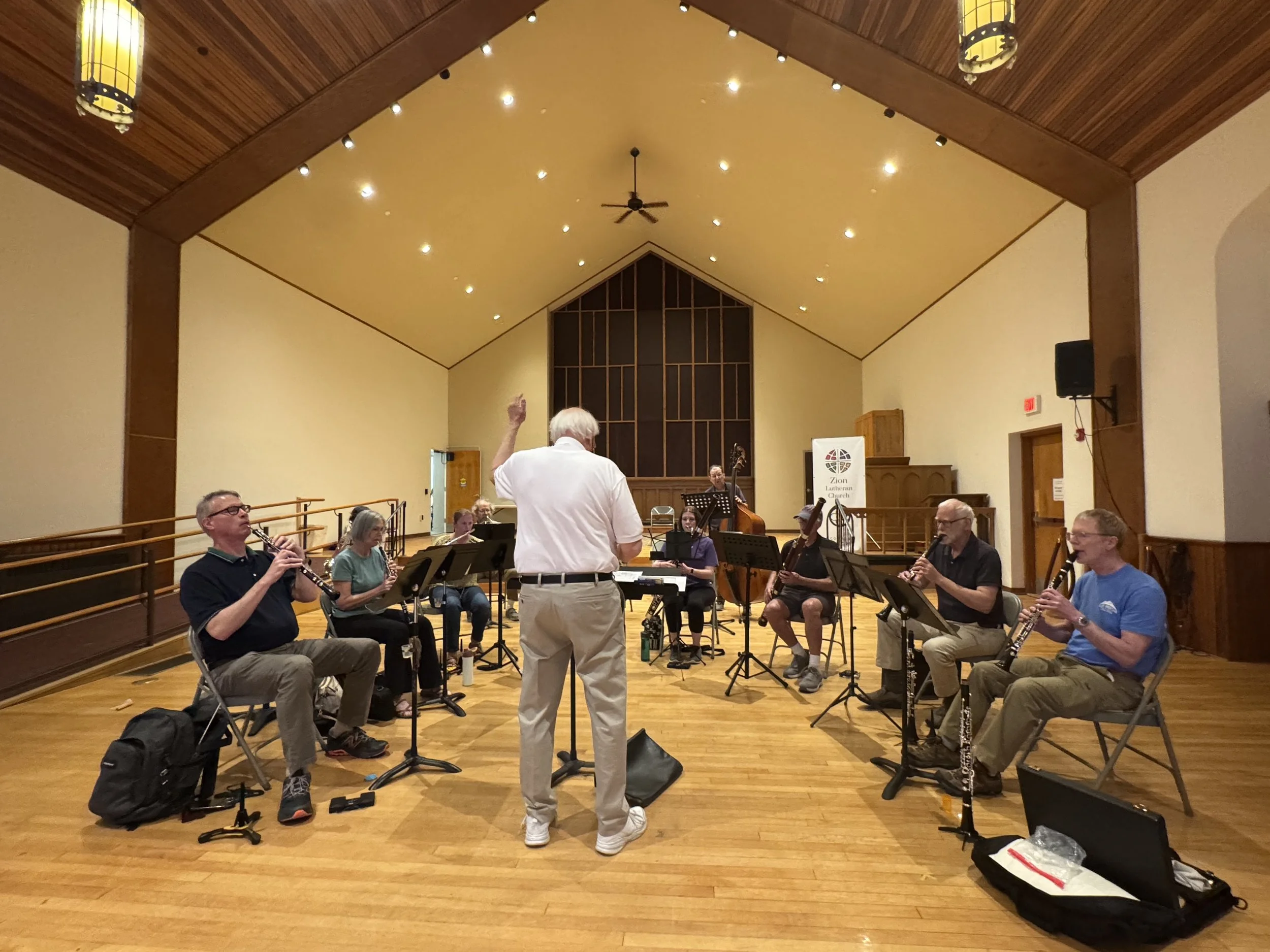
Join us for a program with serenades by Mozart, Antonin Dvorak, and Richard Strauss, representing the classical, romantic, and post-romantic eras. Mozart’s Serenades for Wind Instruments, including #11, featured in this program, are considered the first masterpieces written for Wind Ensemble, inspiring other composers to write pieces for similar instrumentation, including Strauss’s Serenade in E-flat (composed when he was only 17 years old) and Dvorak, who wrote his Serenade for Wind Instruments after hearing Mozart’s Gran Partita.
The concert offers a rare opportunity to hear the selected works in one performance, and experience the connection between these magnificent pieces.
Program Notes
This program presents three works, all serenades, which were influenced by Mozart’s Serenade No. 10, the “Gran Partita.” These influences can be seen in instrumentation and the use of compositional devices; some are very subtle, while others are in “plain sight.” Mozart made full use of the expanded Harmoniemusik octet prevalent in Vienna during his time there, and composers who came afterward benefited from his advancements of the genre.
Richard Strauss’ Serenade in E-flat, Opus 7 was written in 1881 (one hundred years after Mozart’s Serenade No. 11) when he was only seventeen years old. Although he would later say that four horns definitely overpower double woodwinds, the work is nevertheless a brilliant use of timbres and dynamics. Remarkable in the scoring is the use of quartets: flutes and oboes, horns and bassoons, and the horn quartet at the recapitulation.
The work was entitled “for thirteen winds” after the Gran Partita that was erroneously titled “for thirteen winds”. (This error was probably a result of the original Mozart score not being available for study.) Strauss substitutes the flutes for the basset horns, and originally used a contrabassoon or tuba as a substitute for the contrabass.
The Serenade No. 11 in E-flat, K. 375 was composed by Mozart (1756-1791) in October 1781 for St. Theresa’s Day (October 15). Mozart was visiting the sister-in-law of Josef von Hickel, the Viennese court painter, and the Serenade was a gift for her. Mozart wished to impress Herr Joseph von Strack, who was a frequent visitor to von Hickel, and it was Mozart’s hope that von Strack would mention to the Emperor about the quality of Mozart’s music. There were three performances on that day, each receiving an approving welcome. The original 1781 version is a sextet (pairs of clarinets, bassoons and horns). A year later in 1782, Mozart added two oboes to create the octet version, to match the instrumentation of the emperor’s wind band in Vienna.
Five movements comprise the Serenade, with notably two minuets. The Adagio movement utilizes solo oboe, clarinet and bassoon, similar to the Gran Partita.
With an instrumentation of ten winds and two strings, Antonin Dvorak’s (1841 – 1904) Serenade in D minor, Opus 44/B. 77 shows a definite link to the Gran Partita in scoring and length. Written in 1878 over a two-week period, the work was inspired by Czech, Moravian, and Slavic traditional music, very much like the music of his predecessor Bedřich Smetana. This is most evident in the final movement of the Serenade. The premiere performance by the Czech Theatre Orchestra in 1878 was conducted by the composer.
A slight variation in the wind instrumentation (only three horns, for instance), and the addition of the cello to the contrabass gives depth to the harmonic sound. The third movement emulates the syncopated accompaniment and use of solo instruments, much like the Adagio in the Gran Partita.
MUSICIANS
Kelsey Forfa, Beth Devlin – Flute
Julie Martin, Cathy Mohn – Oboe
Gerold Mohn. John Davies – Clarinet
Ashley Jackowski, Jeff Ross – Bassoon
Sam Kennedy, Jean Jeffries, Stewart Edelstein, Chris Mortensen – Horn
Annabelle Hoffman – Cello
Otto Gardner – Double Bass
Chamber Music for Winds
with guest pianist David Anderegg
April 25, 2026
PROGRAM
Schumann, Fantasy Pieces for Clarinet and Piano
Saint-Saens, Sonata for Oboe and Piano
Poulenc, Sonata for Flute and Piano
Mozart, Quintet for Piano and Winds K452 (Oboe, Clarinet, Horn, Bassoon, Piano)
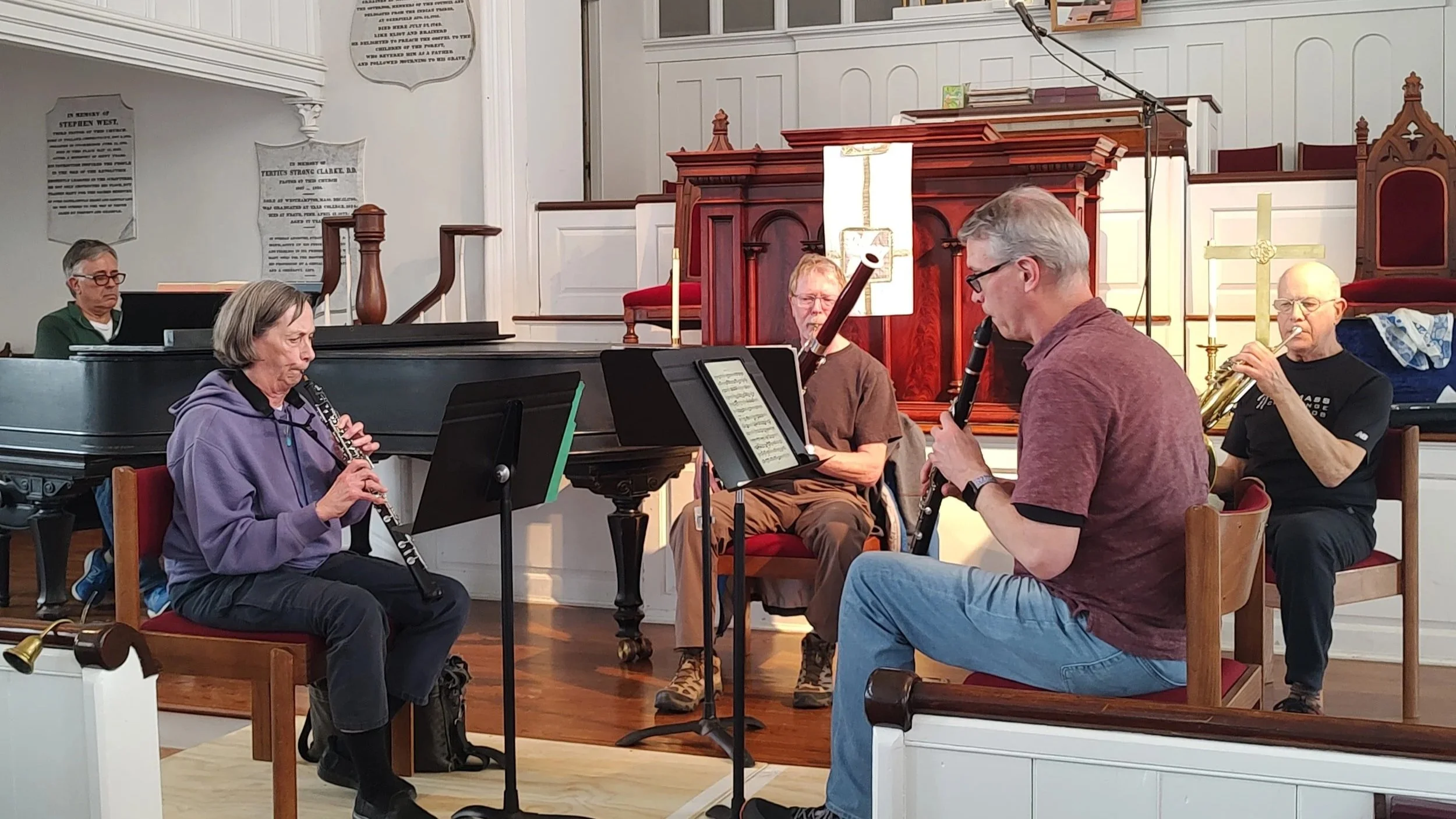
Showcasing the expressive beauty and elegance of individual wind instruments with piano accompaniment, the performance offers a richly varied chamber program that ranges from romantic to playful to refined.
The program opens with Schumann’s Fantasy Pieces for Clarinet and Piano, a set of deeply expressive miniatures that reveal the clarinet’s lyrical soul. Camille Saint-Saëns’s Sonata for Oboe and Piano follows, offering elegance and poignant reflection in one of the composer’s final works.
The program continues with Francis Poulenc’s delightful Sonata for Flute and Piano, a work full of wit, charm, and unexpected emotional depth. The performance culminates in Mozart’s Quintet for Piano and Winds K.452, a radiant masterpiece that brings together oboe, clarinet, horn, bassoon, and piano in a vibrant and conversational ensemble.
Program Notes
David Anderegg
Robert Schumann (1810-1856) wrote his Fantasy-Pieces, Opus 73, for clarinet and piano, but also indicated they could be played on the cello or violin. They have become an important part of the cello repertoire, as well as a cornerstone of clarinet music. He wrote these pieces, originally called “Night-Pieces” over the course of two days during a happy and productive period in his troubled life. The name “Fantasy-Pieces” indicated, for Schumann, pieces characterized by rapidly shifting and intense emotional states. The last movement, with the beginning tempo marking “quick and fiery,” is classic Schumann: in the coda, he tells the musicians to play “Schneller” (faster) and then “Schneller” again. This is only slightly less insane than the first movement of his g-minor piano sonata, which begins with the tempo marking “as fast as possible” and then adds two more “Schnellers” before the ending.
Charles-Camille Saint-Saens (1835-1921) was well-known as the most talented child prodigy in the history of Western music, surpassing even Mozart: in his debut public piano recital at the age of ten, he offered to play, as an encore, any of the 32 Beethoven piano sonatas from memory. Saint-Saens wrote all kinds of music: symphonies, concertos, opera, and chamber music. He lived a long life, and in his later years, he was seen as a once-beloved, but reactionary figure. His traditional Romantic approach to music did not age well in the era of Stravinsky and Schonberg; in 1919, he said of Darius Milhaud’s polytonal symphonic suite Protée, "fortunately, there are still lunatic asylums in France". The oboe sonata dates from 1921, the last year of his life: he undertook a project to augment the repertoire for wind instruments who had traditionally been neglected in the chamber repertoire. The oboe sonata alternates between lyricism and virtuosity, and is a beloved work for which all oboists are grateful. Shortly after completing it, Saint-Saens died in Algiers at the age of 86.
Francis Poulenc (1899-1963) wrote his famous flute sonata upon receiving a commission from the US Library of Congress, which commissioned many of the great works of 20th-century chamber music through a grant from Elizabeth Sprague Coolidge, to whose memory this work is dedicated. (Coolidge is locally famous as the benefactor who built the South Mountain chamber music hall on her estate in Pittsfield in 1918). The first movement, marked “malinconico” or melancholy, and the second, Cantilena, movement are elegiac in nature, but the third is bumptious and playful, almost a can-can in spirit. It is as if Poulenc is grieving, but then laughing in the face of grief, as he so often did throughout his musical career. The piece was a great success at its premiere in 1956 and has been ever since.
The eminent Mozart biographer, Wolfgang Hildesheimer, wrote the following passage in 1977: “Mozart’s creativity reached a high point both qualitatively and quantitatively in the four years from the beginning of 1784 to the end of 1787. In this period he wrote twelve piano concerti; a horn concerto; a symphony; five quintets for various combinations of instruments, among them the (quintet) for piano, oboe, clarinet, horn and bassoon, which he himself, at least at the time of its composition, held to be the best work he ever wrote. It is indeed unique…Each instrument is presented in its deepest individuality; each performs like a virtuoso soloist and at the same time in a cantabile fashion, sometimes playing only one figuration, and then passing it along to the next instrument, which picks it up in a version appropriate to it. It is as if the woodwind sound were dictating the melodic lines.”
MUSICIANS
Cathy Mohn, Flute was principal flute for the Chapel Hill Philharmonia. She played piccolo for the Triangle Wind Ensemble and has played in chamber orchestras for the Berkshire Community Choir and the Berkshire Children’s Choir. Cathy is currently co-principal flutist in the Stockbridge Sinfonia and plays oboe with the Eagles Community Band.
Julie Martin, Oboe played in the Omaha and Alabama Symphonies, freelanced in the Boston area, and now plays in the Stockbridge Sinfonia and the Eagles Community Band.
Lyndon Moors, Clarinet is a very active musician, playing multiple woodwinds in the Eagles Band, Barrington Stage Company productions, and with The Valley Winds. He has played oboe with the Berkshire and Albany Symphonies and was principal oboe of the Bangor Symphony. Lyndon retired from the Mt. Greylock Regional School District in Williamstown after thirty-five years as a band director.
Stewart Edelstein, Horn graduated from the Preparatory Department of the Eastman School of Music, after which he pursued his French horn studies at Oberlin College. He was a founding member of Prevailing Winds of Connecticut, a woodwind quintet, which concertized for more than thirty years. He has performed with the Stockbridge Sinfonia and local chamber groups.
Gerold Mohn, Bassoon, Clarinet has performed with the North Carolina Wind Orchestra, the Raleigh Civic Symphony and Chamber Orchestra, and was a founding member of the Triangle Wind Ensemble. He plays bassoon in the Eagles Community Band and clarinet in the Stockbridge Sinfonia. He also serves as principal clarinetist of the Holyoke Civic Symphony.
David Anderegg, Piano, is an accomplished musician with a diverse background in performance, composition, and collaboration. Anderegg began his musical career as a rehearsal pianist for ballet and modern dance companies in the Boston area. Alongside his professional work in psychology, he has remained active as a chamber and solo pianist, including performing with the Anderegg Trio alongside his children. A founding member of the Mutevoli Ensemble, he first performed Mozart’s Quintet for Piano and Winds over forty years ago.
As a composer and arranger, Anderegg’s works include psalm settings, Christmas carols, popular songs, and two chamber operas, What Owls Do and The Beasts. His recent compositions include Songs from a Bad Year, inspired by the pandemic, Two Vocalizes for Enrique, and the music theater piece A Bigger Angel. He is currently working on a larger theatrical work titled King Toot.